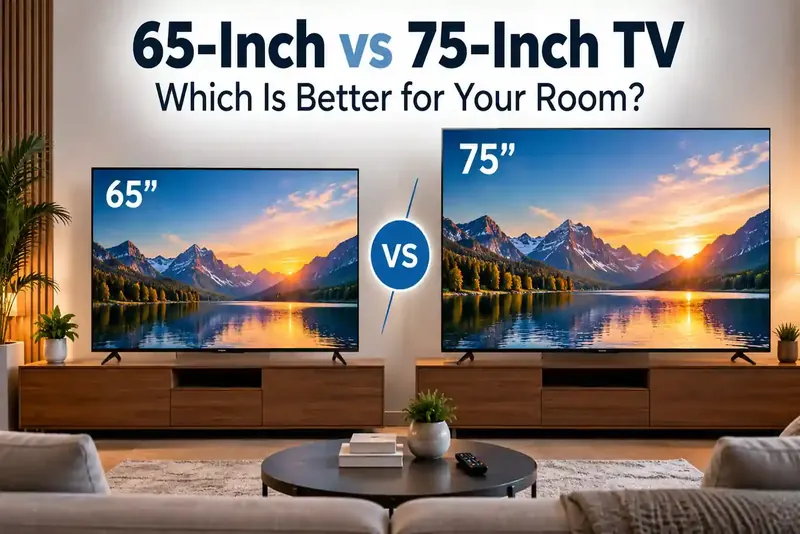
Choosing between a 65-inch and 75-inch TV sounds simple until you actually picture one in your living room.
A 65-inch TV already feels big in many UK homes.
Move up to 75 inches, though, and you get a much more cinematic experience – but you also need enough space to enjoy it comfortably.
So, is a 75-inch TV worth the extra size and cost?
Or is a 65-inch TV the smarter choice for your room?
The answer depends on your viewing distance, room size, budget and what you normally watch.
This guide will help you decide.
65-Inch vs 75-Inch TV: Quick Comparison
If you don't want to get lost in technical details, start here.
| Feature65-Inch TV75-Inch TV | ||
| Best for | Medium to large rooms | Larger rooms |
| Viewing experience | Large and immersive | More cinematic |
| Space required | Less | More |
| Price | Usually lower | Usually higher |
| Gaming | Excellent | Excellent with enough viewing distance |
| Films | Excellent | More immersive |
| Football & sport | Excellent | Great for group viewing |
| Wall mounting | Easier | Requires more wall space |
| Best choice for | Most medium-sized living rooms | Bigger rooms and cinema-style viewing |
Both can be excellent choices.
The important thing is matching the screen to your room rather than simply choosing the biggest TV you can afford.
How Much Bigger Is a 75-Inch TV Than a 65-Inch TV?
Ten inches might not sound like a huge difference.
But TV sizes are measured diagonally across the screen, so moving from 65 inches to 75 inches gives you noticeably more screen area.
A 75-inch television will therefore feel considerably larger when it is sitting in front of you.
That's great if you want films, football and games to feel more immersive.
But it also means you need to think carefully about where the TV will go.
Before ordering either size, measure your TV unit or wall.
Don't assume that because your current TV fits, a 75-inch model will fit too.
Is a 65-Inch TV Big Enough?
For many UK living rooms, a 65-inch TV is already a seriously large screen.
It can give you an immersive experience without completely dominating the room.
A 65-inch TV can be particularly suitable if you:
- Have a medium-sized living room
- Sit roughly 2 to 3 metres from the screen
- Watch a mixture of Freeview, streaming, films and sport
- Want a large screen without taking over the room
- Have limited wall or TV-unit space
- Want to keep the overall cost lower
If you're upgrading from a 43-inch, 50-inch or 55-inch TV, moving to 65 inches can feel like a significant upgrade.
For many households, it offers a good balance between size, price and practicality.
When Does a 75-Inch TV Make More Sense?
A 75-inch TV starts to make more sense when you have a larger room and want the screen to become a major part of the entertainment experience.
It can work particularly well for:
- Large living rooms
- Open-plan spaces
- Home cinema setups
- Watching football with family and friends
- Movies and streaming
- Console gaming
- Homes where the sofa is further from the television
A 75-inch TV can make films feel more cinematic and sporting events more engaging.
If you regularly watch Premier League football, Formula 1, rugby or big films, the extra screen area can be enjoyable.
The key is having enough space to appreciate it.
What Is the Best Viewing Distance for a 65-Inch TV?
There isn't one exact viewing distance that works for everybody.
Picture quality, eyesight and personal preference all play a part.
As a practical starting point, many people will find a viewing distance of roughly 2 to 2.7 metres comfortable for a 65-inch 4K TV.
Because modern 4K televisions have a high resolution, you can usually sit closer than you could with older HD televisions without the picture looking overly pixelated.
If your sofa is around this distance from your TV, 65 inches could be a very comfortable option.
What Is the Best Viewing Distance for a 75-Inch TV?
For a 75-inch 4K television, a viewing distance of roughly 2.3 to 3.2 metres can be a useful starting point.
Again, this isn't a strict rule.
Some viewers enjoy sitting closer because they want a cinema-style experience.
Others prefer sitting further back.
A useful trick is to measure the distance from your normal seating position to the TV wall before deciding.
That simple measurement can make choosing between 65 and 75 inches much easier.
Will a 75-Inch TV Be Too Big for My Room?
This is probably the biggest concern people have when considering a 75-inch TV.
A large TV can look fantastic in the right space.
In a smaller room, however, it can dominate the wall and make the space feel crowded.
Think about more than just viewing distance.
Look at the wall itself.
Will there still be space around the television?
Will the TV block shelves, sockets, windows or furniture?
Will your existing TV unit be wide and strong enough?
If you're wall mounting it, is there enough clear wall space?
A good TV should feel like part of the room rather than something that has been squeezed into it.
Measure Your Space Before Buying
Never rely on screen size alone.
A 65-inch TV does not mean the television itself is exactly 65 inches wide.
The advertised measurement refers to the diagonal screen size.
Actual dimensions vary between models because bezels, stands and designs are different.
Before buying, check the manufacturer's dimensions for the exact model.
Measure:
- Available wall width
- TV unit width
- Distance between the TV and sofa
- Height of the television
- Stand width and depth
- Space needed for a soundbar
- Available plug sockets and connections
If you're wall mounting your TV, check its weight and VESA mounting requirements as well.
65-Inch vs 75-Inch for Watching Football
If football is a big part of your weekend, both sizes can provide an excellent experience.
A 75-inch screen can be particularly enjoyable when several people are watching together.
The larger picture can make it easier to follow the action from different parts of a large room.
But size isn't the only thing that matters for sport.
Also look for a TV with good motion handling, strong brightness and a quality picture processor.
A premium 65-inch TV may sometimes provide a better sports experience than a cheaper 75-inch model.
So don't sacrifice picture quality purely to get a bigger screen.
Which Size Is Better for Movies?
If your goal is creating a home cinema feel, 75 inches has an obvious advantage.
Films simply take up more of your field of view.
Combine a large 4K screen with HDR and a good soundbar or surround sound system, and you can create an impressive movie setup at home.
However, picture technology matters too.
A high-quality 65-inch OLED or Mini LED television may deliver better black levels, contrast and HDR performance than a more basic 75-inch television.
Think about both size and picture quality.
65-Inch vs 75-Inch for Gaming
Both sizes can be excellent for gaming.
If you're buying a television for a PlayStation 5 or Xbox Series X, pay attention to gaming specifications rather than screen size alone.
Look for features such as:
- HDMI 2.1
- 4K at 120Hz
- Variable Refresh Rate (VRR)
- Auto Low Latency Mode (ALLM)
- Low input lag
- HDR gaming support
A 75-inch TV can make racing games, football games and open-world titles feel incredibly immersive.
But if you're sitting fairly close to the screen, 65 inches may be more comfortable because you can see the whole picture without constantly moving your eyes around.
Does 4K Look Good on a 75-Inch TV?
Yes.
A good-quality 4K TV can look excellent at 75 inches.
The higher 4K resolution helps maintain picture detail even on a large screen.
However, the quality of what you're watching matters.
4K films, streaming programmes and modern games can look impressive.
Older or lower-resolution content relies more heavily on the TV's upscaling and picture processing.
If you regularly watch a mixture of HD and 4K content, consider the quality of the TV's processor as well as its screen size.
OLED, QLED or Mini LED for a Large TV?
Once you've decided on 65 or 75 inches, you'll need to consider display technology.
OLED can be an excellent choice for films and evening viewing because of its deep blacks and strong contrast.
QLED can work particularly well in brighter rooms where high brightness is useful.
Mini LED can offer strong brightness and more precise backlight control, making it attractive for HDR, sport and gaming.
There isn't one technology that is automatically right for every room.
Think about when and where you normally watch television.
Should You Spend More on Size or Picture Quality?
Imagine you have enough budget for either a premium 65-inch TV or a more basic 75-inch model.
Which should you choose?
If picture quality matters most, the better 65-inch model may be the stronger option.
If you have a large room and want maximum screen impact, the 75-inch TV may make more sense.
Try not to buy based on size alone.
Compare features including:
- Display technology
- HDR performance
- Refresh rate
- Picture processor
- Smart TV platform
- HDMI ports
- Gaming features
- Sound quality
The best value isn't always the biggest television.
What About Energy Use?
Larger televisions will generally use more electricity than smaller comparable models.
Actual energy consumption varies considerably depending on the display technology, brightness settings, model and how often you use the TV.
If energy use matters to you, check the energy label and product specifications of the individual televisions you're comparing.
Don't assume two 75-inch TVs will consume exactly the same amount of electricity.
65-Inch or 75-Inch TV: Which Should You Choose?
Choose a 65-inch TV if you have a medium-sized living room, want a large screen without overwhelming the space, or would rather put more of your budget towards better picture technology.
Choose a 75-inch TV if you have a larger room, sit further away from the screen and want a more immersive experience for films, football or gaming.
If you're still unsure, get a tape measure.
Measure your viewing distance and the available wall or TV-unit space.
You can even mark the approximate dimensions of each TV on the wall with masking tape.
Seeing the size in your actual room can make the decision surprisingly easy.
Final Thoughts
The difference between a 65-inch and 75-inch TV isn't simply ten inches.
It changes how the television feels in your room.
For many UK homes, 65 inches provides an excellent balance of screen size, picture quality and price.
For larger rooms, a 75-inch TV can create a more impressive, cinema-like experience.
Neither size is automatically better.
The right choice is the one that fits your room, your viewing distance and the way you actually use your TV.
At ShopTVs, you can compare large-screen televisions from leading brands including Samsung, LG, Sony and Hisense.
Explore different 65-inch and 75-inch TVs, compare their features and choose the screen that works best for your home.